
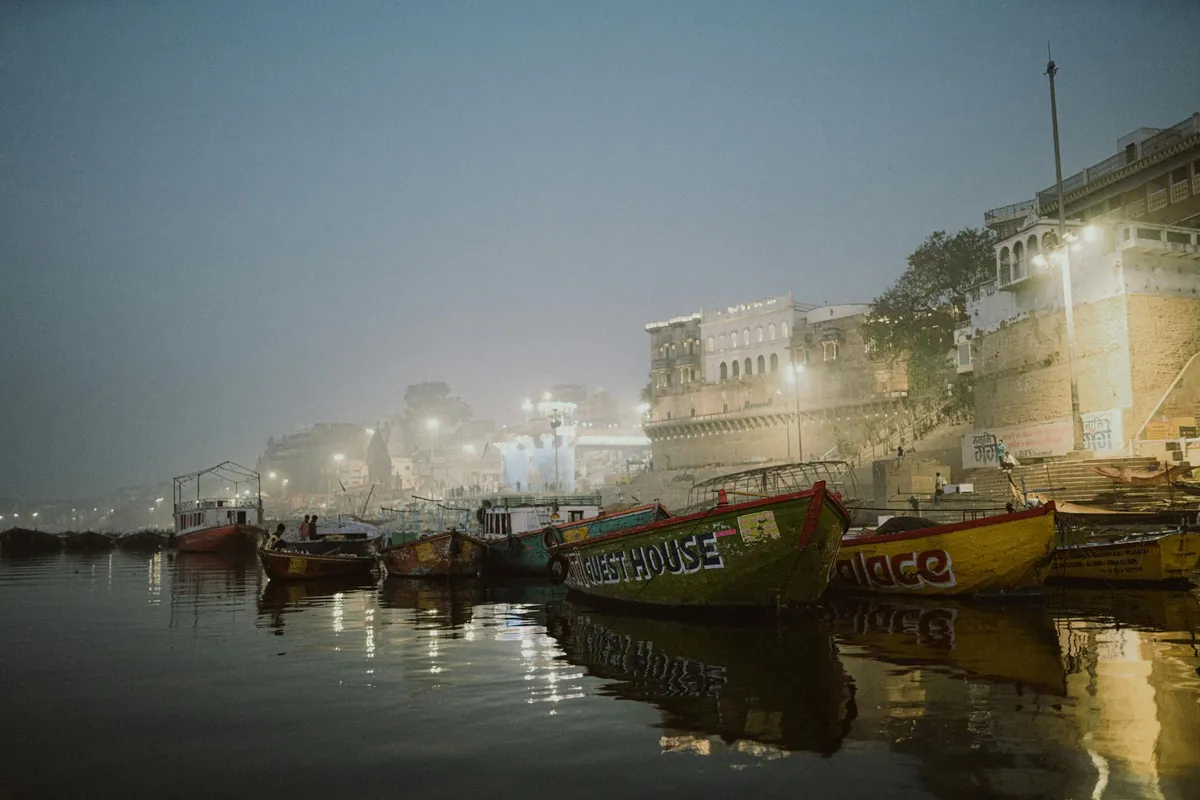
Most travel guides treat Varanasi as a list. The morning aarti at Dashashwamedh Ghat. The evening Ganga aarti at the same place but at the other hour. The walk to Manikarnika Ghat. The boat ride at sunrise. The visit to Sarnath. The temple of Kashi Vishwanath. The narrow lanes of the old city. Each item is described, each item is photographed, each item is fitted into a three- or four-day itinerary that tries to compress the city into a viewable form.
I've done that version of Varanasi twice — once in my twenties, once in my thirties. Both times I left feeling like I'd glimpsed something rather than understood it. On my last visit, I tried something different. Three days, very few specific items, a lot of slow time at the ghats. I want to talk about what that gave me, in case you're planning a visit and want an alternative to the list-based version.
The morning at the ghat — sitting, not sightseeing
The first morning, I went to Dashashwamedh Ghat at five-thirty in the morning, before the morning aarti tourists arrived. I didn't bring a camera. I didn't bring an itinerary for the day. I sat on the steps of the ghat with a small notebook and watched the river wake up.
What I noticed in the first hour was the small economy of the morning. The boatmen rigging their boats. The flower sellers setting up their baskets. The chai vendors lighting their stoves. The first bathers — old men, mostly — coming down with their copper pots and their towels. The pundit at the small shrine doing his morning ritual without an audience because no audience had arrived yet.
This is the version of the ghat that the guidebook doesn't describe. The ghat as a working place, doing its work, before the spectacle starts. Sitting with this for an hour gave me a sense of the ghat as a place of daily life, not just a place of religious tourism. Everything that happens later in the day rests on this morning baseline, which the tourists who arrive at eight a.m. for the aarti never see.
The slow walk through the lanes
On the second day, I spent the morning walking the lanes of the old city. Not with a specific destination. Just walking. Stopping when something caught my attention. Eating breakfast at a small shop that I happened to pass. Sitting in the small temples that the lanes contain, most of which the tourist circuit ignores.
What I noticed in the walking was the layering. The old city is built in layers. Each generation has added something — a shop, a temple, a balcony, a niche shrine. The result is dense and intricate and impossible to take in quickly. The tourist walk through the lanes — the kind that gets done in two hours — covers the route but misses the layering. The slow walk, where you stop and look up and look in, gives you a sense of how deep the city is.
I made it about a kilometre in three hours. By the standards of a walking tour, this is failure. By the standards of seeing the city, this was the most useful three hours of my visit.
The evening with the boatman
On the second evening, I took a boat down the river — not the standard sunset tour, but a longer ride with a boatman who I'd met that morning and who seemed willing to row me slowly past the ghats while telling me what he was seeing. He had grown up on the river. His father had grown up on the river. His grandfather had grown up on the river. He knew the names of the boatmen at each landing, the routines of the priests at each temple, the histories of the small ghats that don't make it into the guidebooks.
The boat ride was longer than the tourist version — about two hours instead of forty-five minutes. The cost was modest — I paid him what felt fair for his time. The information he gave me reshaped my understanding of the city. Where the tourist tour gives you the spectacle of the burning ghats and the sunset over the river, the longer ride with someone who knows the river gives you the texture of an entire community whose lives are organized around the water.
The afternoon I didn't go to Sarnath
I had planned to go to Sarnath on the third day. Sarnath is genuinely worth visiting — the deer park where the Buddha gave his first sermon, the stupas, the small museum with the Ashoka column capital. It's on the standard itinerary for good reason.
I didn't go. I had been to Sarnath before. On this visit, what I wanted was more time at the river. So I spent the afternoon back at the ghats, in a different spot from the morning, watching the day move through its rhythms. The midday lull, when the river is hot and the boatmen are resting. The afternoon return of the bathers. The early evening setup for the aarti, which begins to draw the crowd in well before the actual ceremony.
Skipping Sarnath felt like an irresponsible travel decision until I realized that the alternative — more time at the ghats — was the actual thing I had come for. The standard itinerary would have given me Sarnath but taken away the slow afternoon at the river. The trade-off, on reflection, was clear.
The evening I joined the aarti from a distance
The evening Ganga aarti at Dashashwamedh is one of the most-photographed religious ceremonies in India. Hundreds of tourists arrive, the boatmen line up offshore to give boat-based viewing positions, the photography is constant.
I watched it from a smaller ghat about half a kilometre away. From that distance, you can hear the bells and see the flames against the dark sky, but you don't see the crowd. You experience the ceremony as part of the wider riverscape rather than as a spectacle being performed for an audience.
This was, for me, the better way to experience the aarti. The intimate version requires accepting the crowd; the distant version preserves the sense of the river continuing its life with the ceremony as one element among many. Both are valid. The distant version is rarely recommended, but I want to recommend it.
What the slow visit gave me
What the slow visit gave me, in summary, was a sense of Varanasi as a place where people live, rather than as a city of attractions to consume. The aarti, the boat rides, the temples, the lanes — all of these are real and worth seeing. But they're embedded in a daily life that the list-based visit misses, and the embedding is where the city's actual depth lies.
The trade-off, if you do the slow version, is that you see fewer specific things. You don't make it to Sarnath. You don't do the four-temple tour. You don't cover the recommended itinerary. What you get instead is a deeper sense of fewer things, which I think is the better trade-off for a city like Varanasi specifically.
How to do the slow version
If you want to try the slow version, here's what I'd suggest. Pick a maximum of three or four specific things to see — not ten or twelve. Leave most of your time unscheduled. Spend long stretches at the river without an agenda. Walk the lanes slowly. Eat at places you happen upon rather than places you've researched. Talk to the people who live there — the boatmen, the shopkeepers, the priests at the smaller temples — for as long as they're willing to talk.
Three or four days are enough for the slow version. You'll see less than the list-based visitor, but what you see you'll see more deeply. And the city, slowly, will reveal something that the faster version doesn't.
That's the trade. Take it or leave it. But if you take it, my guess is you'll find the city stays with you longer.