
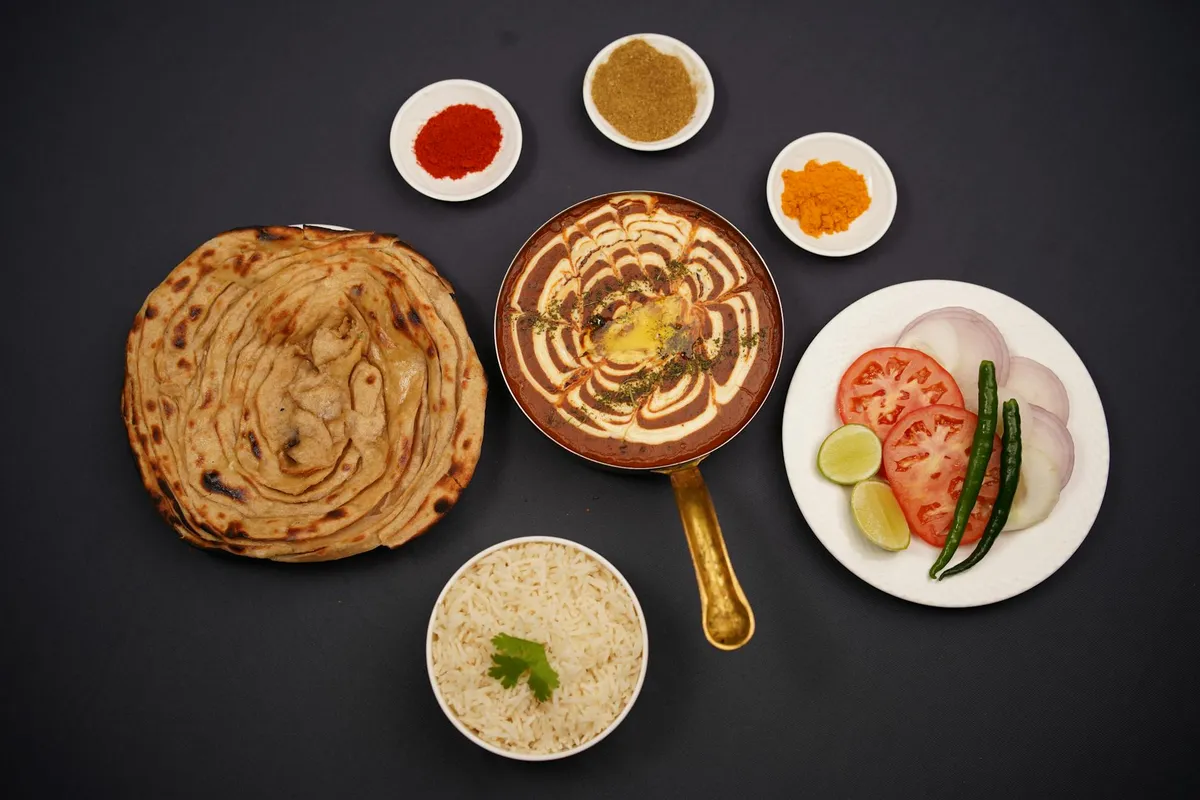
Look. I'm going to give you the recipe. But I want to start by saying that the recipe is not the point. I've had this recipe for fifteen years. I've cooked it dozens of times. Mine is never as good as my mother's, and I want to talk about why, because I think it's actually one of the more interesting things about Indian home cooking that nobody really says out loud.
The recipe
You take a cup of whole black urad dal — the small black lentils with the white inside — and a quarter cup of rajma (kidney beans). Soak them overnight in plenty of water. The next morning, drain and rinse them. Put them in a pressure cooker with fresh water (about three cups), a teaspoon of salt, and a tablespoon of ginger paste. Cook for about thirty minutes after the first whistle, or until the dal is completely soft and starting to break down.
While the dal is cooking, you make the masala. Heat about three tablespoons of ghee (and yes, it needs to be ghee — butter doesn't work the same, and oil definitely doesn't work). Add a teaspoon of cumin seeds and let them sizzle. Add a tablespoon of grated ginger and a tablespoon of grated garlic. Cook for thirty seconds.
Now the tomatoes. Two large tomatoes, finely chopped, or a cup of tomato puree. Cook this down with the ginger-garlic for ten minutes, until the tomatoes break completely and the oil starts to separate. Add a teaspoon of red chilli powder, a teaspoon of coriander powder, a teaspoon of garam masala. Stir for another minute.
Now you combine. Add the cooked dal (along with its cooking liquid) to the masala. Simmer for at least an hour, but ideally two or three. Keep stirring occasionally so the dal doesn't stick. The longer you cook it, the better it gets — the creaminess develops as the lentils break down and merge with the masala.
In the last fifteen minutes, add half a cup of cream and let it warm through. Some people add a tablespoon of butter at the end for richness. Finish with a sprinkle of fresh coriander leaves.
That's the recipe. It's a good recipe. If you follow it carefully, you'll make a perfectly respectable dal makhani.
What the recipe doesn't tell you
Here's what the recipe doesn't tell you. My mother's dal makhani simmers for at least four hours. Sometimes five. She starts it after lunch and we eat it at dinner. The slow cooking changes the dish in ways that I haven't been able to replicate in any reasonable time.
My mother's dal makhani uses ghee that she makes herself, from cream skimmed off the milk that's been boiled in the house. The store-bought ghee that I use is fine, but it's not the same. The flavour is similar but not identical, and that small difference shows up in the final dish.
My mother's tomatoes come from the small vegetable seller on the corner, who knows what she likes — slightly overripe, deeply red, with the kind of flavour that supermarket tomatoes don't have. My tomatoes come from a big-box grocery and taste like nothing in particular.
The bigger thing
But honestly, I think the bigger thing isn't any of these ingredient differences. It's that my mother has been making this dish for forty years. She's adjusted it hundreds of times. She knows, in her hands and her nose and her tongue, what the dal should look like at each stage. She doesn't measure the spices anymore; she eyeballs them, and her eyeballs are correct.
When I cook the dish, I'm following a recipe. When she cooks it, she's following a relationship with a dish she's been in conversation with for four decades. The difference shows up in ways that no recipe can communicate.
What this means for you
I'm telling you all of this not to discourage you. The recipe is genuinely good and you should make it. What I'm telling you is: don't be discouraged when your first attempt isn't as good as the one your mother makes. It won't be. It can't be. You don't have forty years of practice with it.
What you can do is start now. Make it. Adjust the masala next time. Notice what worked and what didn't. Cook it for longer if you have the time. Try a different brand of ghee. Try different tomatoes. Pay attention to the small things. After fifteen years of doing this, your version will be a different dish than your mother's. It might not be better. But it will be yours.
The conversation with the dish
This is, I think, the thing about Indian home cooking that doesn't get said enough. The dishes that mean something to us are dishes that someone has been in conversation with for a long time. The recipe is a starting point. The relationship is what produces the dish you remember from childhood.
If you want to recreate your mother's dal makhani, you can't shortcut into her relationship. You can only start your own relationship. Which means: cook it regularly. Cook it for the people you love. Adjust as you go. Notice what works. After a decade or two, you'll have a dal makhani that's yours.
It won't be your mother's. But it might be the one that your daughter remembers, and that she can never quite get right when she tries to replicate it. The conversation continues. That's how the cooking carries forward.
One last note
If you ever get the chance, stand in the kitchen with your mother while she's making dal makhani. Don't take notes. Don't film it. Just watch. Notice when she adds things, in what order, by how much. Notice what she does with her hands. Notice the small adjustments she makes that she doesn't announce.
The recipe is the bones. The watching is where you start to learn the flesh. You'll never fully transmit what your mother knows; she has it in her hands and her body and her nose. But if you watch enough, you can pick up traces. The traces are worth having. Your future self, in twenty years, will be grateful you stood there.