
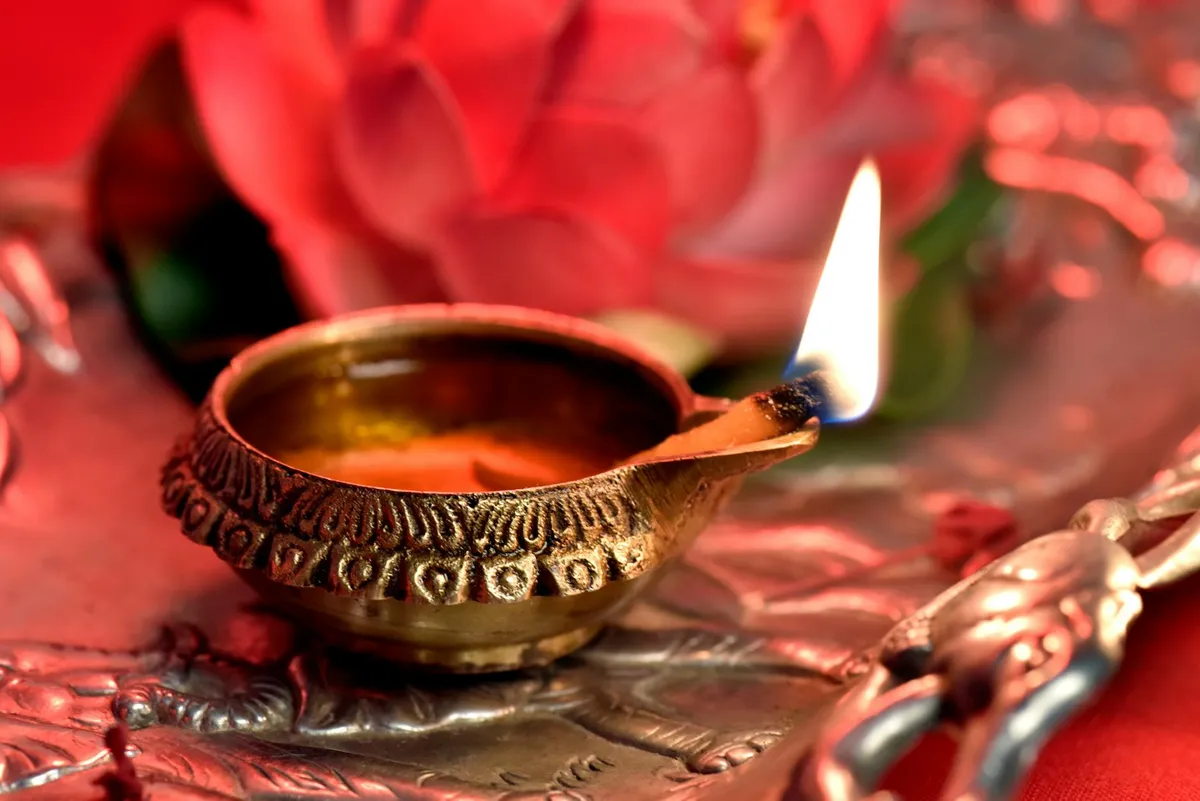
If you've ever watched your grandmother — or really, any senior woman in an Indian household — light the evening diya, you'll have noticed that there's a specific way she does it. The wick gets twisted just so. The oil goes in a specific measure. The match touches the wick at a particular angle. The diya gets placed in a specific spot, and the prayer that follows has its own specific shape.
What's interesting is that if you ask her why, she might not have an explicit answer. "Because that's how it's done," she might say. Or "Because that's how my mother taught me." The specifics matter, but the reasons have often gotten lost. Today I want to walk through some of these specific traditions and what we know about why they exist — because I think the why matters, and because if we don't pass it on, our daughters won't know it either.
The wick: cotton, twisted to a specific length
The wick in a traditional diya is always cotton, and it's twisted to a specific length — long enough to draw oil, short enough to burn cleanly. Honestly, this isn't arbitrary. Cotton burns more slowly and cleanly than other plant fibres. Synthetic wicks would burn faster, smoke more, and produce harsh smells. The cotton wick is the result of generations of trial-and-error optimization.
The twisting matters too. A loosely twisted wick burns too fast. A tightly twisted wick doesn't draw enough oil. The specific twist your grandmother uses is the one that produces a steady, smokeless flame in your specific household conditions — the local humidity, the kind of oil you use, the size of your diya. It's practical knowledge, transmitted through demonstration.
The oil: ghee or sesame, never anything else
The oil in a traditional diya is almost always either ghee or sesame oil. Some traditions use mustard oil. Almost no traditions use refined vegetable oils, even though they're cheaper.
There are practical reasons and there are symbolic reasons. The practical reasons: ghee and sesame oil burn with very little smoke, produce a steady warm flame, and don't leave a residue that fouls the wick. Refined oils produce more smoke and need more frequent wick maintenance.
The symbolic reasons: ghee, in particular, is considered a sacred substance in Indian tradition. It's used in Vedic rituals, in temple offerings, in the foods prepared for festivals. Lighting a diya with ghee carries the same symbolic weight as offering ghee in a fire ritual. The practical preference and the symbolic preference reinforce each other.
The match: never blow it out, always wave it out
You'll notice that after lighting the diya, your grandmother doesn't blow out the match. She waves it through the air to extinguish it, or she touches it to a small bowl of water.
The reasoning is symbolic. The breath that blows out a flame is considered impure in the context of a ritual fire. The flame you've just lit is sacred; you don't want to extinguish anything related to it with breath that comes from your mouth. The same rule applies to incense sticks and to the small auxiliary flames used in larger rituals.
This is a tradition that's easy to dismiss as superstition until you notice that it produces a different kind of attention. The waving-out gesture is slower and more deliberate than blowing out. It's a small physical reminder that you're in a ritual context, not just doing a practical task.
The placement: the threshold, the prayer corner, the kitchen
The placement of the diya isn't arbitrary either. The first diya of the evening typically goes near the entrance to the home — the threshold. The traditional understanding is that this welcomes Lakshmi (the goddess of prosperity) into the house.
The second diya goes in the prayer corner or near the home shrine. The third, in many households, goes in the kitchen — the source of the family's nourishment, and a space that traditionally carries its own sacred weight.
The exact placement varies regionally and by family tradition, but the principle is consistent: the diyas mark out the spaces of the home that the family considers spiritually significant. The lighting is a way of saying "we acknowledge these places, every evening, with light and attention."
The prayer: the specific words your grandmother uses
The prayer that accompanies the diya lighting also has specifics that matter. Some families use a verse from the Vedas. Some use a verse from the local devotional tradition. Some use a prayer in the family's mother tongue that's been passed down for generations and may not be found in any printed text.
What matters less, I think, is the specific text and more the regularity of the practice. The same words at the same time every day, in the same place, with the same gesture. This is what creates the texture of a household's spiritual life. The texture is what your grandmother is transmitting when she insists on doing it her specific way.
What gets lost when the specifics get lost
Here's the thing about all of these specifics: when they get lost, what gets lost isn't just the practical knowledge. It's the framework that the practical knowledge is part of. The cotton wick is practical, but it also carries the symbolic weight of preferring natural materials in ritual contexts. The ghee preference is practical, but it also carries the symbolic weight of using sacred substances for sacred purposes.
When you switch to a synthetic wick and a cheap oil and you blow the match out and you light the diya wherever and you skip the prayer, you're not just doing a stripped-down version of the same practice. You're doing a different practice. The texture is gone. The cumulative attention that the ritual creates over years is gone. You've preserved the form (a diya is lit) but lost the substance (a ritual is performed).
What to do with this
I'm not arguing for fundamentalism. If you can't find ghee, sesame oil works. If you don't know the prayer in Sanskrit, the prayer in your mother tongue works just as well. The point isn't the specific specifics; it's the attention to specifics in general.
What I am arguing for is asking your grandmother — or your mother, or your aunt — to show you how she does it. Watch her. Ask her about the parts you don't understand. Take notes if you need to, although asking her to write it down often produces less than just watching.
The specifics are the texture of the tradition. When the specifics go, the texture goes. And once the texture is gone, you can't recover it from books or websites or YouTube videos. You can recover it only from the people who still carry it. So go ask. While you still can.