
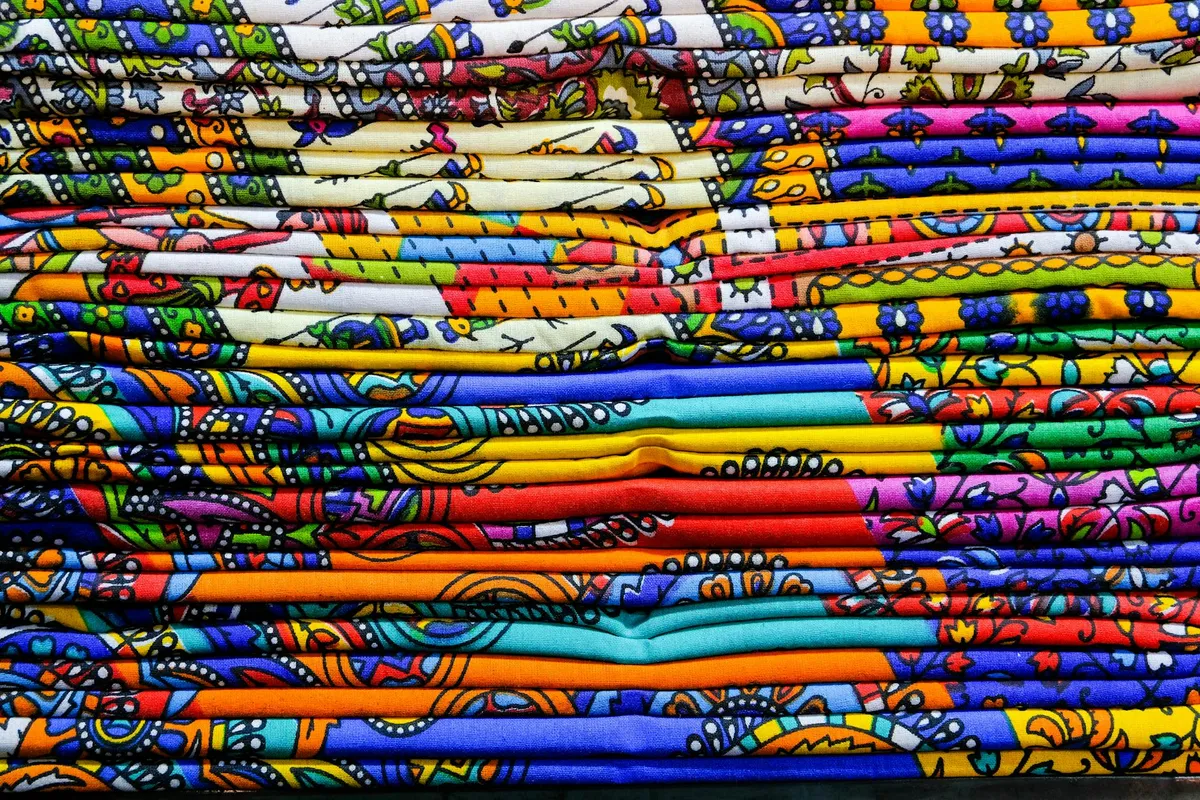
The block-printing workshop is in a small town in Rajasthan, about three hours from Jaipur, in a building that has housed the same family's craft for four generations. The current head of the family is in his sixties. His father did this work. His grandfather did this work. His great-grandfather did this work. He has two sons. Only one of them is interested in continuing.
I visited the workshop last spring because I was writing about the textile crafts of Rajasthan and someone in Jaipur had told me that this particular family was one of the few left who still did the work entirely by hand, with vegetable dyes, without any concession to the screen-printing economics that have largely taken over the regional textile industry. I wanted to see what that looked like, and what kept it going.
The workshop itself
The workshop is small. A central room with long tables for laying out the fabric. A back room with the vats for the dyes. A storage area with hundreds of carved wooden blocks, organized by motif and size. A drying area outdoors where freshly printed fabric is laid out in the sun.
There are four people working when I visit. The head of the family. His older son, the one continuing. Two other relatives — a brother and a cousin, working on commission for specific orders. The atmosphere is quiet. The work requires concentration. Each block has to be aligned precisely with the previous impression. Each color requires its own block, applied in sequence, with the fabric drying between applications.
The motifs are mostly traditional — paisleys, floral medallions, geometric borders. Some are family-specific designs that have been used in this workshop for generations and that you don't see in any other workshop. The blocks themselves are valuable — some of them are over a hundred years old, hand-carved by the current head's grandfather.
The economics, honestly
The economics don't really work. Hand block-printed fabric of this quality takes weeks per piece. Screen-printed fabric of similar appearance can be produced in a fraction of the time at a fraction of the cost. The market for hand block-printed work is limited to people who can recognize the quality difference and are willing to pay for it — which is a smaller market than the wider textile market.
The workshop survives partly on commissions from specific designers and boutique stores that value the hand work. It survives partly on direct sales to visitors who come to the workshop and buy pieces on the spot. It survives partly on the family's own willingness to accept lower margins than would be available if they switched to faster production methods.
The head of the family is clear about the trade-off. "We don't make as much money this way," he says. "But the work is real. Each piece is different. The colors will hold for fifty years. Screen printing fades in five. We are paid less but we have something that is ours."
What the hand work produces that screen-printing doesn't
If you look closely at a hand block-printed piece, you can see the difference. The colors have a depth that screen-printing doesn't achieve — partly because the vegetable dyes penetrate the fabric differently than chemical dyes, partly because each block impression is slightly different and the variation produces a richness that uniform mechanical printing lacks.
The edges of each motif have a slight irregularity. The colors register slightly differently across the piece. There are small imperfections that show that a human hand made each impression. These imperfections aren't flaws; they're the signature of the process, and they produce a piece that has a life that mechanical production can't replicate.
This is the kind of quality that doesn't photograph well. In a catalog image, hand block-printed fabric and high-quality screen-printed fabric look similar. The difference shows up when you handle the piece in person, when you see the depth of color under different lighting, when you wash the piece and observe how the colors hold.
The transmission problem
The bigger question for the workshop is whether the next generation will continue the work. The head's older son is committed. The younger son is not — he works in Mumbai now, in a different field, and shows no interest in returning to the workshop. The two relatives who work on commission have their own families and their own decisions to make about continuity.
The transmission of the craft is not just about training — although the training is substantial; a competent block-printer needs at least five years of apprenticeship. It's also about the network of suppliers, the dyes, the carved blocks, the relationships with designers and stores that make the workshop viable.
If the older son continues and brings in his own children, the craft survives in this family. If something disrupts that — the son moves away, his children pursue other careers, the workshop loses its viable customer base — the four generations of accumulated knowledge largely disappear. Some of it could be documented, but the embodied knowledge of how the dyes behave, how the blocks should be cleaned, how the fabric should be prepared — that requires apprenticeship to transmit.
Why visiting matters
The reason I'm telling you about this workshop is that visiting matters more than buying online, and buying anything matters more than not buying. The economics of the workshop depend on customers who recognize the work and are willing to pay for it. Each direct sale at the workshop, each commission from a designer, each piece bought through a boutique that sources from the workshop — all of these contribute to the workshop's continued viability.
If you're traveling in Rajasthan, find a workshop like this and visit. Spend an hour watching the work. Talk to the head of the family. Buy a piece if you can afford it; even a small piece supports the workshop. The economic effect of one visit is modest, but the cumulative effect of many visitors who care about the craft is substantial.
How to find the workshops
The challenge is finding the right workshops. The Jaipur tourist circuit includes textile shops, but many of them sell screen-printed work alongside hand-printed work without clearly distinguishing. The genuine hand-craft workshops are often in smaller towns, accessed by word of mouth, and not always set up for tourist visits.
The best approach is to find an introduction. The boutique stores in Jaipur that source from hand-print workshops can usually arrange visits for serious buyers. The textile museums and craft cooperatives can point you toward workshops they work with. The artisan organizations like Dastkar maintain networks of craftspeople and can advise.
Once you find one workshop, you'll often be referred to others. The craft community in Rajasthan is small and interconnected. The workshops know each other and refer customers when they think the customer would value what another workshop does.
The longer view
The longer view is that these crafts will continue or not continue based on whether enough people care enough to support them. The economics don't support themselves. The craft requires customers who value the hand work specifically and are willing to pay for it specifically. Without those customers, the workshops close, the apprentices don't get trained, and the knowledge disappears.
If you care about Indian craft traditions surviving, the practical action is to buy from them — directly when possible, from boutiques that source from them when not. Tell your friends about them. Visit when you travel. The cumulative attention is what keeps the workshops viable.
The block-printing family in Rajasthan I visited is one workshop. There are dozens more like it across the country, in different craft traditions. Each one survives or doesn't survive based on the customers it can reach. Be one of the customers if you can. The traditions are worth keeping alive.